In the aftermath of the “Arab Spring,” many analysts proclaimed that it was the death knell of al-Qa`ida and its ideology, while others warned that it would open space for al-Qa`ida to exploit and even potentially take over a government similar to the 1979 Iranian Revolution. These two narratives miss the point. Indeed, jihadist ideology has been marginalized and has opened space for other schools of thought to counterbalance it. Yet, at the same time, in societies such as Tunisia where religion has been suppressed at the hands of a dictatorial government, it has created new opportunities for individuals to organize at the local level, including non-violent political Salafists who sympathize with intellectual aspects of jihadist ideology.

One such Salafist group is known as Ansar al-Shari`a in Tunisia (AST), and its media outlet al-Qayrawan Media Foundation (QMF). It is not clear whether AST was organized prior to the fall of former Tunisian President Ben Ali’s regime, but if it existed beforehand it would have been highly covert due to the repressive environment under the previous government. Regardless, since April 2011 the group’s activities are increasingly public, holding rallies and even creating Facebook pages. AST has garnered the attention of online jihadists at Ansar al-Mujahidin and al-Jahad al-`Alami, two of the most popular Arabic-language jihadist forums.

This article chronicles the rise of AST, showing how the group is a product of the new openness in Tunisian society as well as the liberation of the “public square” in the Arab world as a whole. This new commons has featured a rise in Salafist movements, creating challenges for Western states that want to establish diplomatic relations with new actors in transitioning Arab societies.

To navigate the maze of new actors, it is crucial for Western governments to go beyond understanding the old Islamist parties linked to the Muslim Brotherhood (as well as the secular and liberal trends), but also the growing prominence and broader trend of Salafist movements in Tunisia and the Arab world.

Read the rest here.

I am restarting Jihadology a little later than I had intended, but after completing Middlebury’s immersive and intensive language program I needed a break from doing much of anything. That said, if anyone has the opportunity to do Middlebury’s Arabic program, I highly recommend it. Also, I want to thank everyone that sent me an email over the summer saying they were looking forward to the return of Jihadology. Over the past few months jihādĩs have released 100s of new primary source materials. Unfortunately, I currently do not have the time to add all of them to the site, but I have them all saved in my personal archives so if there is anything anybody is interested in having please email me and I will be sure to add it to the website.

Fun fact: I broke the news that Ẓawāhirī was the new amīr of AQ in Arabic. I also, recently wrote a post at al-Wasat if you have yet to see it titled “What’s in a Name: The Death of the al-Qa’ida Brand?” And if you have library access the academic journal Terrorism and Political Violence published a book review I did on Nelly Lahoud’s excellent book The Jihadis’ Path to Self-Destruction. In the coming week or two I should be having a few new articles coming out as well. Be on the look out for those.

It’s good to be back!

Last week, Ansar al-Shari’ah, (Supporters of Shari’ah), based in Yemen, released its first video titled “The Opening [Conquests] of Zinjibar.” Since mid-April, many analysts and scholars have wondered where this apparently new group came from, who its members were, and what connections it has to al-Qa’ida in the Arabian Peninsula (AQAP).

The name Ansar al-Shari’ah was first mentioned in an unofficial audio release by AQAP’s leading shari’ah official, Shaykh Abu Zubayr ‘Adil bin ‘Abdullah al-Abab, who conducted a question and answer session with online global jihadi activists through PalTalk in Ghorfah Minbar al-Ansar (Pulpit Room of the Supporters). The first question was “What is the general situation of the mujahidin in Yemen and the status of the Shabab Ansar al-Shari’ah?” al-Abab responded that when they recruit new members to AQAP, they first introduce themselves under the banner of Ansar al-Shari’ah. But why would they need to do that? Has the AQ brand really become that tarnished? And is Ansar al-Shari’ah really AQAP?

Some have been skeptical of links between AQAP and Ansar al-Shari’ah. While conclusive evidence is lacking, there are several strong indicators. Ansar al-Shari’ah’s first video release, which was not published by AQAP’s media outlet al-Malahim (the Epics), highlighted “martyrs” who were also eulogized in the most recent issue of AQAP’s Inspire Magazine — Abu ‘Ali al-Harithi, ‘Ali bin Salih bin Jalal and ‘Amar ‘Abadah al-Wa’ili. Although this is not proof of collusion, there clearly seems to be some overlap. Ansar al-Shari’ah may be a subsidiary of AQAP used for recruitment and foot soldiers in Yemen’s incipient civil war. It is telling that AQAP may be recruiting individuals using a different name.

We have also recently learned that Usama bin Laden may have been looking to change the name of al-Qa’ida central. According to press reports based on leaked information from the raid that killed bin Laden, al-Qai’da’s central leadership in Pakistan was debating a couple of options for its name. This was spurred in part by the Western habit of referring to the group as al-Qa’ida, rather than its official name of Tandhim Qa’idat al-Jihad (The Base Organization of Jihad). The leadership felt that the West’s habit of omitting the word “jihad” robbed them of some of their religious legitimacy. Unfortunately for al-Qa’ida, the two alternative names on the table were a mouthful – Ta’ifat at-Tawhid wa-l-Jihad (Sect of Monotheism and Jihad) and Jama’at ’I‘adat al-Khilafah al-Rashidiyyah (Restoration Group of the Rashidun Caliphate). Ultimately, they decided to stick with Tandhim Qa’idat al-Jihad.

The name game isn’t new. al-Qa’ida in Iraq (AQI) attempted to rehabilitate its image following the death of its leader,  the notorious butcher Abu Mus’ab al-Zarqawi, in 2006. AQI changed its name to the Islamic State of Iraq (ISI) as a way of rebranding itself because many Iraqis were repulsed by the organization’s overuse of violence, as well as the perception that it was made up of foreigners. The latter is also the reason they announced Abu ‘Umar al-Baghdadi, a purported Iraqi, as their new leader, although it has been disputed whether he was actually a real person. In the years since, the name change has not done much for AQI’s credibility. It remains a threat, but is a shadow of its former self.

Another place where naming is an issue is in Somalia, where Harakat al-Shabab al-Mujahidin (The Movement of the Holy Warrior Youth) has pledged allegiance to Osama bin Laden but has not changed its name to become an al-Qa’ida franchise. Leah Farrall recently wrote an excellent overview on this topic in the most recent issue of the CTC Sentinel. Although it is a great addition to the literature, there were also other explanations for the lack of formal name change. Reportedly, al-Qa’ida itself opposed the name change because it did not want al-Shabab to sully its so-called “street cred” by using its polarizing brand. It is difficult to ascertain whether these reports are credible. But the very discussion shows the growing pitfalls of the al-Qa’ida brand.

All told, the al-Qa’ida brand is not favorable anymore – even for its senior leadership. It’s a big problem if AQAP is able to recruit more individuals by rejecting the brand and taking on a name with more religious significance.[1]

Even if the brand name is discredited, AQ’s ideas still resonate with many, especially if it can be repackaged for local contexts, as in the apparent case of AQAP. As we have seen in the past, AQ is a very nimble organization that learns, evolves, and quickly adapts to a rapidly changing “battlefield.” It would be wise for our policy makers and government officials to heed these subtle changes in its counterterrorism strategies. Otherwise, we are fighting an imaginary enemy, one that only exists in our minds or that existed in 2001 or 2008, but not in 2011.


[1] Ansar or the supporters played an important role in early Islamic history when the Muslim prophet Muhammad was still preaching and calling people to Islam. Ansar were the individuals in Medina that helped Muhammad and his followers following its hijra from Mecca. Therefore, the use of the term Ansar acts as a strong link to the past that appeals to the average Muslim. Further, when attaching it to the Shari’ah, which has primacy in the lives of religious Muslims, Ansar al-Shari’ah becomes a catchy and useful name that is stronger in Islamic terms than Tandhim Qa’idat al-Jihad.

‎كنت أود أن اكتب عن شيء في العالم الجهادي في اللغة العربية لذلك منذ يومين رايت في موقع منبر التوحيد والجهاد رسم جديد (الذي فوق). إنه يعلن أن ينضمام هاني السباعي إلى اللّجنة الشرعية منبر التوحيد والجهاد. أظن أن السباعي هو الشخص الأول من الغرب ينضم إلى اللّجنة الشرعية منبر التوحيد والجهاد‫.

.

‎منذ سبتمبر ٢٠٠٩ السباعي يشغل موقع ‫‬مركز المقريزي للدراسات التاريخية‫.‬ يعيش السباعي في مدينة لندان الأن ولكنه من أصل مصري‫.‬ ويعتقد أن السباعي كان عضوا في شورى تنظيم الجهاد في مصر‫.‬

.

في سبتمبر ٢٠٠٥ أُضيف السباعي إلى قائمة الأمم المتحدة ١٢٦٧ لجنة منع الأفراد‫.‬

.

‎ارحب بالأفكار من الآخرين عن هذا الموضوع‫!‬

Since I started Jihadology almost thirteen months ago, it has always been a side project of mine that I do in my free time. Unfortunately, this summer, I will not have the free time to maintain the website. I will be continuing my Arabic language study at Middlebury College, where there is a language pledge. Meaning it is completely full immersion and therefore, I will not be allowed to speak, write, read, or listen to anything except for in Arabic. Therefore, I will be unable to update this website in English. In the course of thinking about how I could get around this,  I thought maybe I could continue this website in Arabic during the summer, but I do not believe it would be feasible since I will be extremely busy and I do not want to take away from my learning (which will hopefully allow for an even better website when I complete my study). Therefore, between June 7 and August 7 this website will go dark. Sorry for any inconveniences. I look forward, though, to the day when I return at the end of the summer and able to continue this website. I will still have access to email during the summer (since the program knows it is nearly impossible to completely shut out English language influences with todays technologies), so if you have any inquires, questions, or comments I will still be reading my emails: azelin [at] jihadology [dot] net. That said, my goal is to follow the spirit of the language pledge, which is why this website is going on hiatus.

Thank you for the continued support and I hope everyone has an enjoyable summer.

For the past few months I have been pondering some ideas regarding how to conceptualize jihadi media and how it has evolved over time. In light of a vigorous debate a month or so ago (this post got delayed) on Twitter and Will McCants’ post at Jihadica about the efficacy of jihadi organizations using platforms such as Facebook or Twitter, I thought I would finally test the waters with a rough sketch, which can hopefully be fleshed out further and/or begin a healthy debate.

Jihadi Media Since Maktab al-Khidmat

Although I am only interested in jihadi media online, there has been four different phases of how jihadi media has been predominantly disseminated since 1984. The latter ones are not necessarily mutually exclusive to the former ones. The dates correspond to adoption of medium:

Phase 1 – 1984: Khutbas, Essays/Pamphlets, Printed Magazines/Newsletters, and Video-taped lectures and/or battle scenes.

Examples: ’Abdullah Azzam’s tours in Europe and the US at a variety of Mosques, publication of Join the Caravan and al-Jihad Magazine, and a variety of old school VHS-type videos that came out of Afghanistan, Bosnia, and Chechnya.

Phase 2 – Mid-1990s: Top-down websites

Examples: al-Neda and Azzam Publications

Phase 3 – Mid-”aughts”: Forums

Examples: al-Hesbah, al-’Ikhlas, al-Fallujah, Ansar, and Shamukh.

Phase 4 – Mid to late “aughts”: Social Media Platforms

Examples: Blogs, Facebook, YouTube, and Twitter

Defining the Different Types of Online Media

Top-down Websites.

This is a completely centralized endeavor where the individual owning a Web domain (who is connected with jihadi organizations) holds complete monopoly over what content is important and highlighted. Top-down websites have total control over the content.

Forums.

Administrators of the forums help facilitate and disseminate content on behalf of jihadi organizations. Additionally, they post important news items and have the power to delete threads and ban users. Therefore, they help steer the online community in a certain direction by not allowing users be exposed to certain content or dissent. At the same time, the users now have a role in posting a variety of materials, including their own views on events, and the ability to converse with like-minded individuals spread across a dispersed geographic area.

Social Media Platforms.

The individual is in control of the content. One can post news articles on Twitter and Facebook, create videos on YouTube, or write articles and/or essays on one’s blog. The individual, not the organization, decides what is important and what they believe should be given the most attention.

Take Away
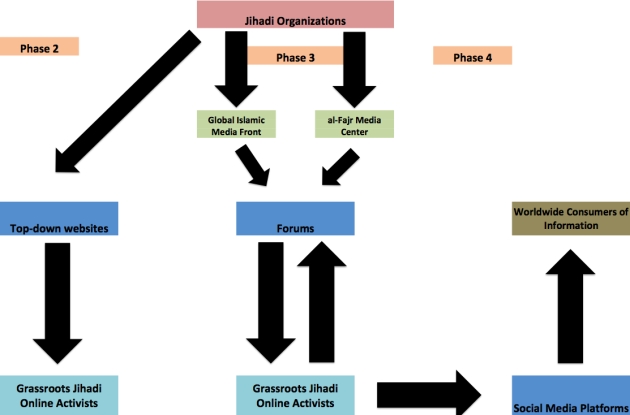
Over the past 15 years there has been an enormous shift in the ownership of production and consumption of jihadi media. During the mid-90s through 2003/2004 jihadi groups had a monopoly on who produced and disseminated jihadi materials online, which allowed al-Qaeda and other organizations to continue to be more elitist in nature. The parallel onset of the forums with the rise of Abu Mus’ab al-Zarqawi somewhat evened the playing field. The forums allowed administrators (who were connected with jihadi organizations) to still have somewhat of a monopoly over what was posted on the forums by deleting threads or banning members, but individuals online who were not connected in a first degree manner to al-Qaeda or other jihadi organizations could now not only consume what was posted by administrators, but comment in those threads as well as post their own content that they came across or originally produced as well. The most recent Web 2.0 innovations and creation of social media platforms has completely upended the old monopolized control over the production of online jihadi media. As a result, the ideology of global jihadism is no longer an elitist clique, but has been appropriated at a social movement level, albeit at the fringe. Social media platforms have created global jihadi entrepreneurs of news items, originals articles and essays, tribute videos and anashid, etc. Therefore, over time, due to newer technologies being adopted the bar became lowered for being able to participate and be a part of the global jihadi movement.

The convergence of the invasion of the Iraq war with emerging technologies that encourages online communities were large factors, which gave more opportunity to the individual. The individual jihad became individualized for those off the battlefield. Before, one could only really fight or give money. This gave a new power to a whole new group of individuals. By doing so empowering a whole generation and metamorphisizing global jihad into a social movement versus more of an elitist clique. On the web one can talk about it all day even if one is geographically dispersed. One couldn’t do that in the 90s or in early “aughts.” That’s what makes it unique. The biggest thing that it has done and I hate to use the phrase, but the flat worldization and boot-strapization of global jihad. There can be an “American dream” of jihad if one does it correctly: Abu Dujanah al-Khorasani, Samir Khan, etc.

This is why it does not matter if al-Qaeda is officially on social media platforms. They already have a whole army of online media entrepreneurs that spread its gospel to the furthest ends of the Internet. The forums are the hub where the organization meets the grassroots, which is why although social media platforms are the nodes that bring the global jihadi message to non-global jihadists the forums will not become obsolete. It is a place where the global jihad is headquartered online. The social media platforms are where the product or ideas are sold. It has opened up a whole new recruiting ground that exposes the global jihadi message to anyone, whereas before, one had to knowingly want to be exposed to the global jihadi movement by going to the forums. These individual online entrepreneurs can replicate their message multiple times over. We may be in a golden age of online da’wah to the global jihadi social movement.

This raises the question of whether this will lead to more individuals joining the global jihadi terrorist movement or whether the social movement will dilute the global jihadi message and/or moderate it by normalizing the idea that it is okay to cheerlead at home instead of fighting, especially individuals in the West. As the past has shown, some individuals will be zealous no matter what, therefore, even if a portion of the global jihad is confined to ones computer, the message is still spreading and there will be some that go out and attempt an attack. As a result, it is crucial to understand how online jihadi activists promote their ideas to non-global jihadis in popular social media platforms.

I will come back to this subject more in-depth in the medium term.

Earlier this morning, I had the opportunity to talk with J.M. Berger the author of the recently released book Jihad Joe: Americans Who Go to War in the Name of Islam. We discussed a variety of topics:

  • The evolution of Americans involved in jihadism since the Soviet-Afghan war
  • The biggest names in the American jihādī movement that one should know, but are unknown to the vast majority of individuals
  • How Anwar al ‘Awlaqī has changed since the 1990s
  • What role Web 2.0 has had in changing the nature of how Americans interact with the jihādī movement
  • Whether there is a uniqueness to the Americans in AQ
  • How American jihādīs have reacted to the death of UBL
  • Trajectory of American jihadism in the next 5-10 years

Berger has been a journalist for more than 20 years. He also has written and produced multimedia content for National Public Radio, Public Radio International, the National Geographic Channel, and more. He has written for the Boston Globe, the San Francisco Examiner, and other major newspapers. Berger runs the terrorism news and analysis Web site, Intelwire.com.

Jihad Joe: Americans Who Go to War in the Name of Islam

Click the following link to listen to the interview: Jihadology presents its first podcast with J.M. Berger, the author of “Jihad Joe: Americans Who Go to War in the Name of Islam”


Three days ago, the Tahadi Islamic Forum released a statement titled “Declaration of Independence.” They are cutting off correspondence with other forums including the premiere al-Qaeda forum Shamukh al-Islam. This is because they believe they have been strangling open debate. By gaining such independence, Tahadi explains that they will have more legitimacy now and that it will better conform to Islamic principles. Tahadi hopes their forum lives up to its reputation as a place of free-flowing conversation. More interesting than the statement itself is how the grassroots online jihadis have reacted. Two major schools of thought have played out: 1. excitement and 2. confusion. Here are some examples:

Abu Muhammad al-Qurayshi: We ask God for the facilitation of a unified jihadi media.

Abu Muhtasib: God knows how happy this decision is, which came … to correct the path of the media jihad and maintain the existence of integrity and independence.

al-Mustashar al-Khas: We are tired of the life of humiliation and they treat us like slaves.

Abu ‘Abd al-Rahman al-Sayf: Blessings upon God to you, but I did not understand the reason [for the declaration].

Abu Qa’qa’ al-Najdi: Did Shamukh get struck/infected like al-Fallujah (previous top AQ forum), please clarify if possible.

Abu Hafs al-Sunni al-Sunni: My brothers did not understand the meaning of this independence, God bless you. Is it possible any of you can guide me and explain to me this decision? May God reward you.

Dhakwan: You did well to end this problem/widespread phenomenon in the jihadi forums.

Hindkushi: God expected that [Tahadi] will be [given] the courage to speak the word of truth found in the current jihadi forums, then praise God who showed me after I lost hope for a long period of time.

Asad al-Islam: We do not understand what is intended [by this independence].

Abu Dhar al-Maqdisi: A courageous and successful step, God willing.

Khadim al-Jihad: Perhaps a good initiative to restore the good old days for us.

Although many forum participants were relieved, unsure how to react, and wanted more information for guidance, one forum member named Hamam Harith believed it was a bad idea by asking what benefit the jihadi media and forums will get from this “independence.” Also, some forum goers did not understand if it was a clean break from affiliating with other forums or whether it included media outlets too such as al-Fajr Media Center or the Global Islamic Media Front. If Tahadi were smart one would suspect that they would provide a follow up statement with more details. Unfortunately, I do not have access to Shamukh al-Islam Forum, since it is privatized, and they no longer accept new registrants. As such, I will rely on Aaron at Internet Haganah for some more details as well as to provide more historical context since there have been forum fights in the past including al-Hesbah and Tajdeed.